
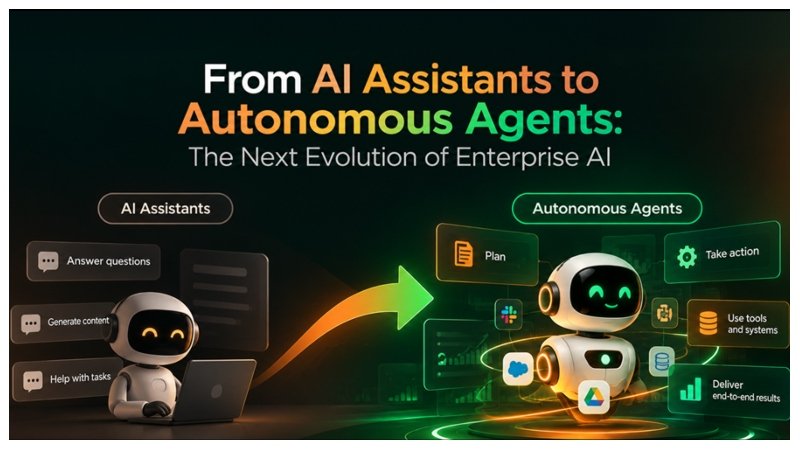
Most enterprises running AI today have a chatbot or copilot answering questions somewhere in the business. Very few have anything that acts on those answers without a person finishing the job by hand. It’s a major issue and a reason why so many AI pilots stall out right after the demo ends.
This guide breaks down what separates an assistant from an agent and which of your workflows are ready to make that leap. It also covers how AI agent development services turn that readiness into something running in production instead of sitting in a slide deck.
What Changed Between an Assistant and an Agent
An assistant answers what it’s asked and stops. An agent takes a goal, breaks it into steps, and carries those steps out across whatever systems the task touches. The distinction sounds small until you watch what it does to a team’s actual workload. Most enterprises exploring AI agent solutions right now are really asking a narrower question. They want to know which of their existing assistants are ready to stop waiting for a person to finish the job.
● Why “Assistant” Became the Default First Step
Assistants rolled out first because they were low risk. A chatbot that drafts an email or summarizes a document can’t do much damage if it gets something wrong. That made assistants an easy sell to leadership and a safe pilot for IT. The tradeoff is that a company can run assistants for years and still have every action bottlenecked through a person copying, checking, and approving.
● The Missing Ingredient Was Trust
The models behind agents and the models behind assistants overlap heavily. What’s different is the confidence a company has in letting software touch a live system without a person in the loop for every step. Building that confidence takes guardrails, logging, and a track record, which is exactly what most companies skip when they first experiment with automation.
Five Signs Your Company Has Outgrown Assistants
- Staff spend more time relaying assistant output than acting on it themselves
- The same three-step manual process follows every AI-generated recommendation
- Nobody can say how many hours get lost to copying results between systems
- Leadership keeps asking why a tool this smart still needs a person for every action
- The team has stopped trusting the assistant’s output enough to skip double-checking it
Two or three of these points together usually mean the assistant has already done its job and the company is ready for something that can act. That’s the point where most companies start seriously scoping AI agent consulting work instead of running another assistant pilot.
A national retailer noticed the pattern in its returns process last year. An assistant summarized every return request and suggested an approval or denial. A staff member still keyed in every decision by hand, and the queue kept growing faster than the team could clear it. Once the company let a governed agent execute the straightforward approvals itself, the backlog cleared within three weeks. The staff who used to key in decisions all day started reviewing only the returns with a genuine dispute attached. That’s the kind of outcome most AI agent solutions are built to produce once a company is ready for one.
What Autonomous Agents Look Like In Practice
Reliable services turn that readiness into a working system a team can run day to day.
● Finance And Accounts Payable
An assistant can flag an invoice that looks off. An agent checks it against the purchase order, confirms the vendor against an approved list, and either releases payment or routes the one case that needs a person, all without anyone opening a queue first. This is the kind of task a team building its own AI agent solutions program usually tackles first, because the rules are clear and the volume makes the payoff obvious fast.
● Customer Support And Account Management
An assistant can draft a reply to a billing question. An agent pulls the account record, checks the billing history, resolves the straightforward request, and only escalates the cases where judgment genuinely matters. One telecom support team cut its average resolution time by more than half within the first quarter of running agents on refund requests. The team credits that outcome directly to the AI agent development services engagement that built the guardrails before launch.
● Sales Operations And Pipeline Management
An assistant can summarize a sales call. Well-built AI agent solutions go further than that. An agent updates the deal record, schedules the follow-up, and drafts the next email in sequence. It also flags a deal at risk based on how long it’s been sitting untouched, all without a rep opening five different tools to piece that together manually. A mid-market software vendor rolled this out for its renewals team and freed up roughly a day a week per rep, time that now goes into calls with accounts showing genuine signs of churn.
● HR And Internal Operations
An assistant can answer a question about vacation policy. An agent processes the actual leave request, checks it against team coverage for that week, updates the scheduling system, and only pings a manager when two people on the same team request the same week off. A logistics company running this setup cut its HR team’s ticket load by nearly a third in the first two months, freeing that team to spend its time on hiring instead of routine paperwork. Few HR teams would describe themselves as candidates for AI agent development services, which is exactly why this example tends to surprise people the most.
AI Assistants Versus Autonomous Agents
Neither option is universally correct. A workflow with real financial or legal exposure needs the governance an agent requires, while a low-stakes drafting task may never need to graduate past an assistant at all. Sorting workflows into these two buckets is usually the first exercise in any serious round of AI agent consulting, well before anyone commits to a build.
The Case For Bringing In Outside Expertise Early
Most internal teams have built a chatbot or two. Far fewer have built the orchestration layer, the guardrails, and the monitoring an autonomous system needs to run safely in production. That’s where a short round of AI agent consulting earns its cost before a single line of production code gets written. A few weeks of scoping work tend to surface the integration gaps, data quality issues, and approval bottlenecks that would otherwise surface mid-build, when fixing them costs far more.
Companies that skip this step often rebuild their first agent from scratch within a year, once the gaps that scoping would have caught start showing up as production incidents. A short AI agent consulting engagement also gives a company an honest read on which workflow to start with. The wrong first choice can sour an entire organization on the idea before a second attempt ever gets funded.
How Much Autonomy To Grant, And When
Autonomy isn’t a single switch. It’s a set of stages most companies move through gradually, and mapping those stages well is exactly the work a strong AI agent solutions partner should walk in ready to do.
● Observe, Recommend, Act
An agent starts in observe mode, watching a process without touching it. It moves to recommend mode, suggesting an action a person approves. Only after that track record builds does it move to act mode, taking the action itself within defined limits. Skipping straight to act mode on an unfamiliar workflow is how confident, wrong decisions happen at scale, and it’s the single mistake experienced AI agent consulting teams warn clients about most often.
● Setting Limits That Hold Under Pressure
Spending caps, approval thresholds, and restricted data access all belong in this layer, enforced independently of what the model itself suggests. Well-designed AI agent solutions treat these limits as fixed rules the system cannot reason its way around, even when the model seems confident enough to override them.
Most companies that skip a stage might face issues within months. For instance, an agent might handle an edge case badly enough to shake staff confidence. Mapping these stages accurately is one of the more valuable things a round of AI agent consulting does before a single guardrail gets written.
Risks That Come With Removing The Human Step
- An agent that resolves cases quickly but silently gets more of them wrong
- Guardrails written once at launch and never revisited as the agent takes on new cases
- No clear owner for the system once the initial project team moves on
- Staff who route around the agent because nobody explained what changed
- A vendor relationship that ends at deployment instead of continuing through the first year
Watching for these early costs is far less than discovering them after an agent has been running unsupervised for months. Most of these risks trace back to the same root cause, which is treating AI agent development services as a one-time purchase instead of an ongoing relationship. One manufacturer learned this after an inventory agent kept reordering a discontinued part for six weeks before anyone checked its logs. Nobody had been assigned to own that review after the original project team moved to a different initiative.
Metrics That Show The Rollout Is Working
A handful of numbers separate a healthy rollout from one drifting off course without anyone noticing. Track the percentage of cases an agent resolves without escalation, how often a human reviewer overturns the agent’s decision, and how long it takes staff to stop double-checking work the agent already verified.
A resolution rate that climbs while the override rate holds steady is the clearest sign a rollout is on track. A resolution rate that climbs while overrides also climb usually means the guardrails need tightening before the agent takes on more volume. Most in-house teams only learn to run that check after an outside AI agent solutions partner sets up the first dashboard.
A Rollout Plan From Assistant To Agent
Moving from assistants to agents works best as a sequence of small, deliberate steps. Pick one workflow with clear rules and a real volume problem. Run it in observe mode long enough to trust the pattern. Add guardrails before the agent ever takes a live action, then expand into the next workflow once the first one holds up under real traffic. Enterprises that hire full AI agent development services for this transition tend to move through these stages faster than teams building it entirely from scratch. The guardrail and monitoring work has already been solved elsewhere and doesn’t need reinventing.
Budget for the handoff as carefully as the build itself. An agent that runs well on day one still needs someone checking its logs on day ninety, and that ownership question is worth settling before launch, well before the first quiet failure surfaces.
What It Takes To Run Agents In Production
An assistant that only drafts will always need someone to finish the job. An agent removes that step, but only once the guardrails are built first. Start with one workflow. Run it in observer mode before it touches anything live. Add autonomy in stages, not all at once. Businesses looking to expand beyond individual agents can also explore broader artificial intelligence services to support AI adoption across multiple workflows.
Please visit my site, Itplaybattlesquare, for more details.